
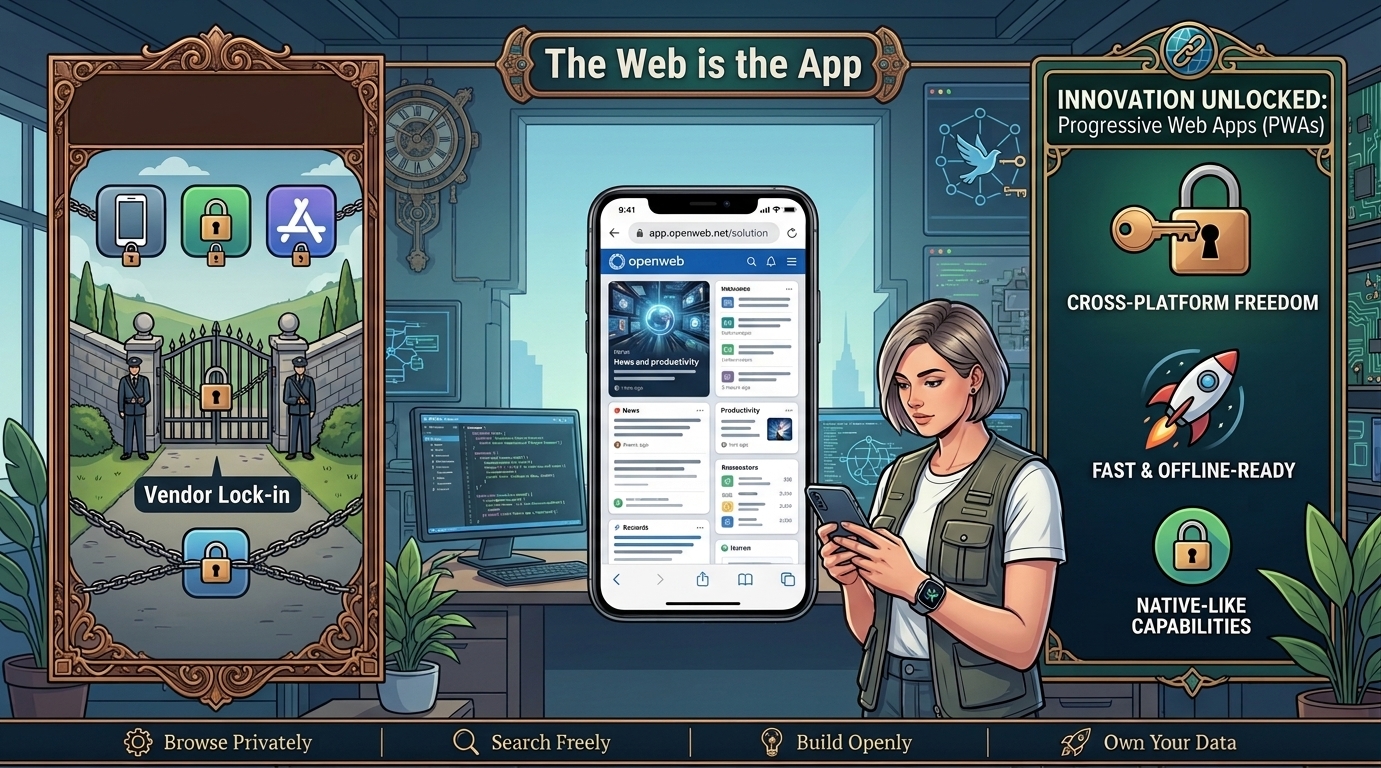
I'm not here to waste your time, so here's the answer up front to the clickbaity title: the web. Yes that's right, the web is the answer to the problem of mobile apps. But of course the story as to why mobile apps are a problem and how the web solves this is a longer and more nuanced story than fits in a single sentence, so if you have a few minutes to learn more, then please read on.
Steve Jobs had it right when he said (to paraphase) that web apps are all you need when the iPhone first came out (video of the WWDC 2007 clip, Apple's announcement at the time). Sadly he didn't have the technical nouse to actually make that happen and so at the first opportunity ditched the idea for the easier and more lucrative option of running an app store. Of course that was to be expected, Apple doesn't innovate, that's not their strong suit: they are good at polish and marketing.
So while there were no real existing examples of web apps for mobile, there definitely were for locked-down, proprietary app stores for mobile phones, so Apple could just polish that concept up and spin it out for their customers. Sadly that set the trend so that with Android, Google went down the same path, and then the likes of Zuckerberg, who was equally lacking in technical and engineering ability, failed to oversee the making of a good web app for Facebook, so instead of taking responsibility blamed HTML5 and web apps instead and likewise moved on to milking his customers and shipping mobile apps.
Of course, having been first an Android and then a Flutter mobile app developer for over 15 years, I have to shoulder my share of the blame for perpetuating this state of affairs. While the whole time I have loudly advocated for web apps and against the myopic purism in the mobile app dev community of "not using web views" (especially bad I found on iOS), I have to admit that by working in the industry this whole time I was part of the problem of perpetuating and increasing the use of mobile apps.
So why are mobile apps even an issue? Well, to start with, they don't solve a problem users have. No, instead mobile apps are a solution to problems app developers and platform vendors had. For developers, who are by human nature lazy, the problem was that in the early days, the web platform and browser APIs were very limited and fragmented and it required a lot of engineering effort to get nice, usable and performant UIs on mobile web browsers, so using native OS UI toolkits was a useful shortcut to shipping more usable apps quickly, so of course app developers leapt at the option.
For platform vendors Apple and Google, the problem that needed solving was platform lock-in. At the time they were the newcomers up against the dominant industry giants and their device offerings were inferior technically to the incumbents as well, so what to do? Well, lock-in your users of course! They knew perfectly well that locking in users to their platforms with applications that were only available on their platform was by far the best marketing strategy and especially for Apple this was again the preferred tactic and they certainly ran with it. Jobs may have despised Microsoft, but Ballmer's monkey-dance of "developers! developers! developers!" was undoubtedly his strategy to build iOS into market dominance.
Once locked into their respective app platforms, Apple could use its monopoly power and hegemony over developers to inflict whatever arbitrary or capricious edicts it wanted and, sadly, when it comes to the users, Google, as expected from an ever more powerful multinational corporation, has followed suit, adopting many of Apple's worst tactics and policies when it comes to the Play Store.
Meanwhile for actual users, the web was and is the best solution. It provides both security and identity verification (in the form of SSL and HTTPS), interoperability and discoverability via URLs, with the absolute minimum of external control and governance via DNS.
So why am I so confident that mobile apps are a bad idea and that the web can be used instead? Well, it's because the evidence is already right in front of us! From messaging apps like Slack and Discord, to shopping sites like Amazon, social media sites like Facebook, Instagram and Reddit, online video like YouTube or iView through to Google Maps and even banking apps: ALL OF THEM HAVE A WEBSITE that you can use on a "desktop" OS web browser to do the same thing you do on the mobile app on your phone!
While some are more usable on the smaller touchscreens than others, they all exist! Some like Reddit are particularly obnoxious in their constant nagging for users to install a mobile app instead of actually using the website the user actually navigated to! They do actually all work.
In fact for the most part, mobile apps simply are little specialised web browsers, but re-implemented in an ad hoc and usually inferior way to actual web browsers. Just think about the apps, especially social media or shopping apps you use on a regular basis, and how much of their functionality is simple web browsing, all just wastefully re-implemented using the platform OS's UI toolkit or the vendor's add-on toolkit such as SwiftUI and Compose or a third party UI toolkit such as Flutter.
As I mentioned above, in the early days of mobile touchscreen phones, the web platform was limited and difficult to work with on mobile browsers and web views, but this is no longer the case and has not been for a number of years. The web platform on mobile has progressed and matured. We now have installable web apps, notifications, web workers for offline use, state-of-the-art toolkits like React and APIs for even things like contacts and low latency audio via the Web Audio API, WebGPU and Web MIDI and so much more.
Also why now is because: despite the good work being done by the EU (see its DMA rules on app distribution) to drag Apple, kicking and screaming like a petulant toddler, to allow alternate app stores on iOS devices, it seems that Apple are intent on complying as little as possible with this and are restricting any changes they are forced to make to customers in the EU only. Even more sadly, it seems that Google's corporate approach to Play is to become more and more like Apple, continuing to enforce ever harsher requirements on the developers and users of its Play Store and even increasingly limiting the ability of users to install apps directly on their own devices (the insidiously labelled "sideloading" when its proper term is "normal installation").
Of course the question also needs to be put: what is the huge disruption being caused by agentic LLMs going to do in this space? I can't see the future any more than anyone else can, but I suspect that the web again will prove to be key in allowing agents to be useful rather than the little walled gardens that mobile apps provide, even on platforms like Android, which provide a rich modular API for inter-app interoperability.
Having been part of the problem, I've decided that I should now try to be part of the solution. For me this will take not only the form of advocacy like this article, but also an experiment in ridding myself of as many mobile apps as possible from my daily-use phone.
For those who want to try this for themselves, I would advocate that you, gradually and as far as you are comfortable, also remove the apps on your phone one by one and replace using them with the equivalent websites and web apps.
Finally I also have some ideas on how to make it even easier and more pleasant for end users to make use of web apps on their phones, which I hope to write more about soon.
Until then, I wish you all a happy and safe today and tomorrow in these very uncertain times.
Get new posts delivered straight to your inbox. No spam, unsubscribe anytime.